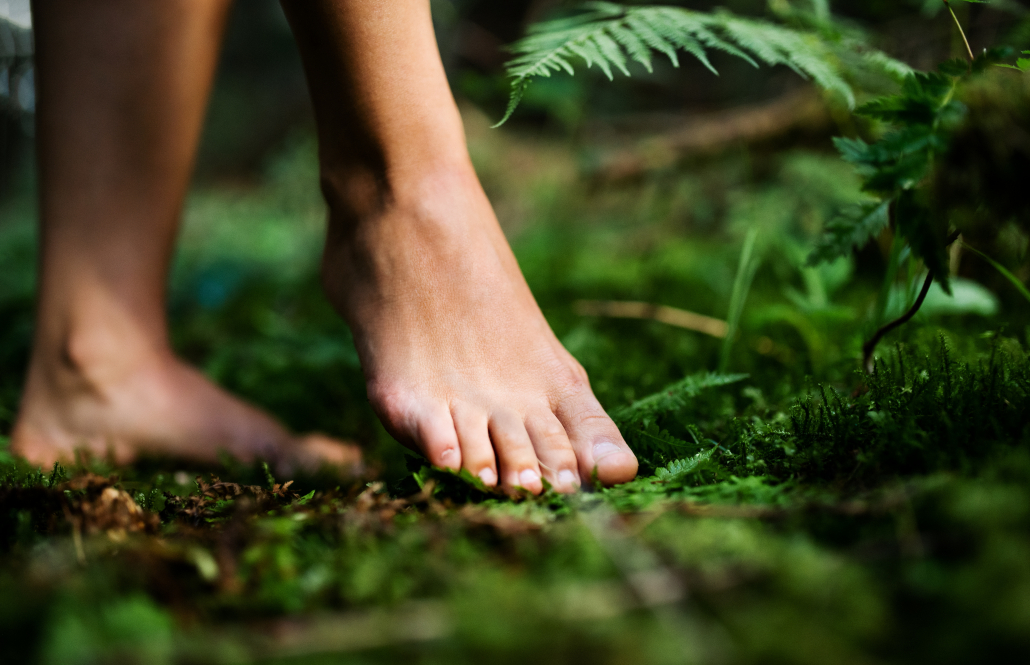
“Earthing is about having direct skin contact with the surface of the Earth, whether it’s your bare feet, your grounding hands or other parts of your body,” Dr. Albers explains. The theory is that when we physically connect with the ground, its electrical energy rebalances our own. Proponents believe that the rise in chronic illnesses can be attributed, in part, to our footwear.
“They point out that we’ve just recently started wearing shoes with rubber soles, which don’t conduct electricity,” she continues. “So, part of the argument is that we’ve removed that contact from the Earth, which is making us unwell.”
Grounding vs. earthing
If you’ve heard of grounding, but not earthing, you may be wondering: Are they the same thing? You’ll get different answers depending on who you ask. It’s common to use the terms interchangeably, but Dr. Albers sees grounding and earthing as two specific (but related) things.
According to Dr. Albers, “grounding” is an umbrella term for a wide range of mindfulness techniques, including physical grounding activities like earthing. So, all earthing is grounding, but not all grounding is earthing.
“I use the word ‘grounding’ to describe psychological techniques for addressing anxiety that help you to refocus on the present moment — on the here and now — and distract from anxious feelings and intrusive thoughts,” she explains.
One of the reasons Dr. Albers distinguishes between grounding and earthing is that not all grounding exercises involve connecting with the Earth. You can ground yourself physically in many ways, including stretching, doing breathwork and engaging your senses (think holding an ice cube or rubbing a fuzzy blanket).
Ways to practice earthing techniques
As you might expect, there are debates about the merits of different earthing techniques. Some earthing adherents think direct contact with the ground (or a natural body of water) is absolutely necessary. Others believe you can get the same benefits by using special electrical conduction products.
Indoor earthing
Not everybody has equal access to Mother Nature. And Dr. Albers is quick to note that some mental health disorders make it hard to feel safe in uncontrolled or unfamiliar surroundings.
Enter indoor earthing! There’s a whole cottage industry dedicated to bringing the benefits of the great outdoors inside. You can buy products that claim to bring the energy of the Earth to you, including:
Mats.
Shoes.
Blankets.
Mattress pads.
Adhesive patches.
7 claims about earthing’s benefits
There’s not much research on the health benefits of earthing. And a lot of the research we do have is of questionable quality — sometimes because the sample sizes are too small to be meaningful, sometimes because the study is poorly designed and sometimes because of flawed data analysis. Even good research on the benefits of earthing is too preliminary to base conclusions on. Nevertheless, proponents claim that integrating earthing into your life can:
Improve mood and reduce stress.
Improve sleep and prevent or treat fatigue.
Reduce inflammation.
Speed healing and reduce pain.
Improve immune system function.
Improve multiple heart health metrics.
Modulate autonomic nervous system function.
 Site Title
Leave a comment